
Course Content
-
0 / 4
Mountain Dulcimer Sample Lessons
-
0 / 4
Hammered Dulcimer Sample Lessons
-
0 / 1
Chromatic Dulcimer Sample Lesson-Erin Mae Lewis
-
0 / 1
Dulci-Bro Sample Lesson-Steve Eulberg
-
0 / 1
Fiddle Sample Lesson-Vi Wickam
-
0 / 10
Sample of Live Stream Archive
-
Learning-How We Learn to Play Music
-
Theory-Dulcimer Range Comparison
-
Skills and Techniques-Finding a Daily Rhythm for Practice

-
Performing-Keys and Building Set Lists

-
Technical Considerations-Is It My Dulcimer or Is It Me?
-
Tools-Using ALL our Tools to Assist our Practice

-
Genre-Bluegrass-Strategizing Solos

-
Tune Time-Devil in the Strawstack

-
Instrument-Specific-Dulci-Bro
-
Down the Rabbit Hole-Bowing with the Mountain Dulcimer
-
-
0 / 1
Want access to our entire course library?

Instrument-Specific-Dulci-Bro
32:04
Good morning, friends.
Welcome to the Wednesday live stream from Dulcimer Crossing.
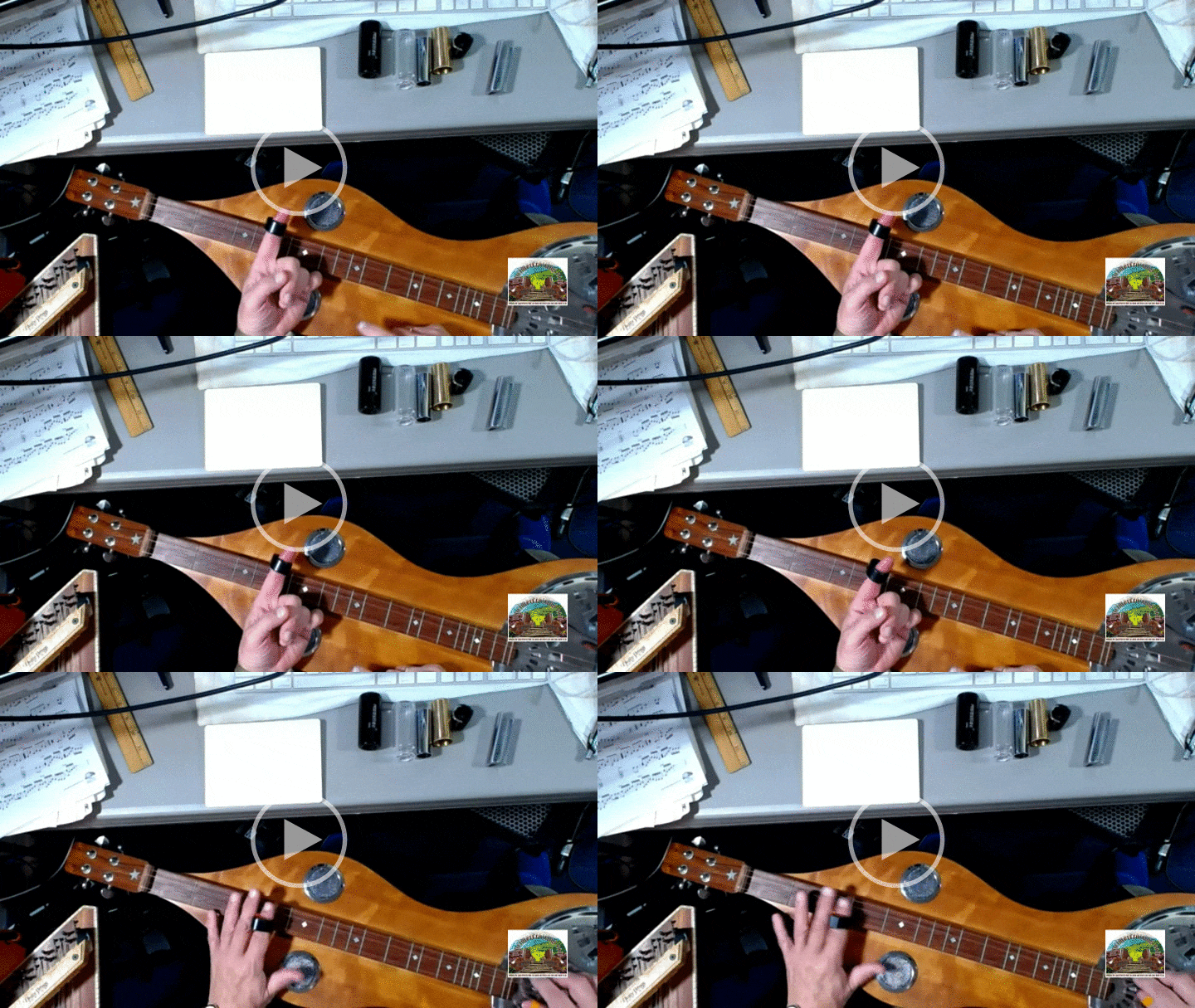
Today, our topic is going to be slide dulcimer do this on a Dulci-bro resonator and I'll show you an overhead view of this.
Beautiful instrument.
This one was built by Don Neuhauser.
It's got a full quarterman cone resonator, which is like a speaker that's facing up, And there's a spider bridge that touches the outside edges in about 8 points or so and transfers the vibrations from the strings to the outside of the the speaker cone, which then it amplifies it and it resonates.
The rest of the instrument is a bit bigger than a standard dulcimer.
You can see if I lay this one on top, the other one has, a good bit of space around it in order to both accommodate the quarter McCone and to help produce the tone.
I play with finger picks and I play with a raised nut.
The nut that's raised gets the strings.
You can see they're never gonna touch the fretboard because I'm depending on a slide to do that.
And I'm gonna talk about the kinds of slides I use as well as the variations that we have in the different kind of, well, let's see what's going on here.
I think we can remove you as a layer.
You're just getting in the way right now.
There we go.
So but the question also comes up, can I play slide on a standard instrument?
So we're gonna address that too.
So why don't we just dive right in right now and, talk about why first, why do I wanna play a slide dulcimer?
And I gotta tell you it's because I love the sound.
I just love the tone.
Let me do that all with the overhead view so you can hear it, see it from the overhead.
So because I have a lifted nut, I can play any of the notes all along any one of the strings, which means this is much more like the human voice.
I can sing in the cracks between the notes on the piano, for example, between the frets on a standard dulcimer.
And the kind of, slide I use will have an impact.
So let's just go take a look at my slide collection here.
And why don't we see if we can zoom in on that?
I guess I gotta move it over here.
We're gonna zoom in that far.
The one I use the most is the one that looks kind of like a steel.
I beam this is, SP, Dobro slide.
It lays on my second finger like this.
My first finger sits in that top groove and my thumb rests along this other side.
The other slides that I have here are the kind of slides that if I'm playing on this instrument, I'm going to hold in the same way between my fingers.
If I was playing on a guitar, I would put the slide over my finger like that.
This one's a mud slide, which is ceramic.
I've got a bottle slide, which is glass.
I've got a tapered brass slide, which fits over my ring finger.
The other ones don't.
Well, the bottle slide does.
It can fit on my ring finger.
The other ones fit on my pinky.
And then there's a, chrome slide.
That's not tapered.
You can, by putting them side by side, you can see this one's got a little bit of a conical bore.
And then there's these two interesting ones that can sit right on top of your finger.
So only one finger slides and the other fingers can play chords and things like that.
And, this is the newest one to me.
This has got no weight.
This is one that being Futch, uses and recommended.
And I'll go over that in a little bit.
But, right now, let me back out the, the zoom here so we can get back to the instrument and I'll demonstrate the different kind of tones from the different slides.
I'll leave the slides in the picture so you can see them.
So this has got a lot of mass to it, a lot of weight.
So the difference in playing with the slide is that instead of being right behind the fret, when I'm going for good tone, like I would in a standard dulcimer, What I'm going to do is hover right over the fret, and I'm gonna let these three finger these, ring and pinky rest on the strings on that side, on the knot side.
So I don't hear Because as I go up over here, these are getting lower.
I don't wanna hear those tones.
I just wanna hear the ones on this side.
Finger deadens those.
It also helps anchor me where I am on the instrument.
And then I have a 4 string equidistant setup.
You can count the strings here.
I have it tuned to D F Sharp a D.
So it's an open major chord.
There are varieties of tunings as well, but this is the one I use the most.
So there are some adaptations that need to happen in order to play, the tunes we might know on our mountain dulcimers on this instrument.
And I've taught several classes in, introduction to, playing dulci-bro.
In fact, let me, let's go here.
Hang on.
I put together there are a couple of resources that could be helpful for you and one is I'm gonna share my screen.
If you just go to dulcimercrossing.com, you can see that we have an introduction to the Dulci-bro class on the front page with a sample lesson, a description of what's in the class.
This is an introduction, 21 different video lessons in 5 different, modules that lets you get started.
Within the Dulcimer Crossing website, we also have those lessons available to all of our members and if you click on sort by instrument, you'll see everything we have for Dulci-bro, which is the same thing.
It turns out with this one though, we have 63 different, lessons that are here.
So the intro gets you started, but within the site you get 63 different lessons and we cover all the techniques here, left hand, right hand techniques, all those kinds of things.
Let's see.
There's links to the kind of picks I use here.
There are also, let's see, some performances, several different performances here.
I'd also have a let's stop sharing that.
I also have a resource that I published called, Let me find it here quickly.
Here we go.
This is, I've published a book that is has got a lot of the same information.
Some of us do better with books than we do with, video, but this has got a book and a CD.
It's also downloadable.
This is order form for a physical one, but there is a, a downloadable version, that has MP threes, but it's got a CD so you can hear everything.
So those are some different ways to to support the learning of this instrument.
In addition, we have a Facebook page, Dulci-bro resonator dulcimer that you can, join.
One of the things I learned as I pay attention to what people are doing there is that several people like this in this kind of instrument, not for the slide way of playing, but because they like the tone and they have their strings without the nut lift flat on the instrument.
So it's like a resonator instrument.
Questions in here.
Are there other other genres besides blues, Hawaiian and country where you're gonna hear this kind of a this kind of a sound?
Actually, there are several, there are several rock bands who have used slides as a piece of what they do.
One of the students I'm working with yesterday was working on George Harrison's my sweet lord.
The, the genres that are most well known are Hawaiian.
The instrument was developed here in the mainland.
It went to Hawaii, everybody in the mainland forgot about it.
It got adopted and brought back, and it's like, wow.
What is the cool thing that went away and came back and now we love it?
And brought Hawaiian music back, And then, country music would use it, and then it got highly developed in the pedal steel area where there's more strings and, pedals and levers being used by foot and legs to change the tones.
And there is not much that got recorded in Nashville in the sixties that didn't have a steel guitar in it somewhere.
Blues has always been more of an usually an unplugged kind of thing, but it, it graduates from playing with bottlenecks and and bottle and, pocket knives and things on an open tune guitar.
And that all of these are trying to imitate the human voice in some way.
I see Doug, you have one of those, one of these slides for your banjo.
Yep.
And Jim, you're talking about the pocket knife.
Yes.
I've used that.
In fact, he's no longer with us, but Steve Miklos did a workshop at the, Albany Festival many, many years ago that I got to go to, and he didn't have quite enough slides to go around.
I said, you just I pulled out my pocket knife and used that as my slide, and it was about playing slide on the standard instrument.
Still gonna get to that.
But first off, I wanna show I want to demonstrate there is a tonal difference when I use different slides made out of different materials and different weights.
So this is the, this chrome one that's quite heavy and it's got a meaty kind of tone with it.
Now let's go backwards and here's the brass slide.
I can fit this on my finger, but to play in this instrument, I need to have these things behind it.
You can hear a slight difference based on both weight and substance.
Now this is a chrome one.
That's weight is between this one and this one.
Still not quite as meaty as that one for my taste.
Now the bottleneck, which is the lightest of all of them.
Now this one's called a mudslide.
It's made out of ceramic.
And it's got the darkest kind of tone, which I really kind of like, especially when I'm playing on guitar.
So that's one of those, that's one of those, slides that I like to play on my guitar, but I still prefer my, my standard Dobro slide.
There are some that are look like torpedoes as well.
Now let's look at this one, which is you can see it's got a big thick side on this side, so there's a weight on it.
It's got a little spring loaded catch to make it fit my finger, whichever finger I use and wherever I want it.
It's the it's possible to play 2 notes at a time, but it's pretty challenging because the the spread of the notes here and the width of the slide itself are close to each other.
So it's real easy to fall off the string.
On this instrument, I do not prefer to use this because I want to cover all the strings the same way with this one, which is very light.
It's got a Velcro, thing on the back.
You can cut this so it fits your finger, which is what I've done.
This one's a little wider than the other one, so it's much easier to play 2 strings.
And it doesn't it doesn't give me the tone that I'm looking for using this one on the raised nut instrument.
But now let's go and try this, all this out on a standard dulcimer.
And let's zoom in just a little more.
Now you can see I've found the nut is covered over by my capo.
Let's lift that up.
There's not much space in there.
This is a standard dulcimer.
It doesn't have the resonator to change the tone.
So let's go backwards through the slide.
I can get that tone.
I have to hold this very light.
And it gets that kind of down home juke choke joint kinda sound.
The difference between this one and the resonator that I had is that this one has no third in the chord.
So it's always power chords.
They can always be either major or minor by strumming all the strings on the resonator.
One that has 4 strings.
I've got to skip this one, which always tells me it's a major chord.
I can pluck and get the outside, the bottom string, and the a and the d and get the sound with the resonator cone.
Now here's the S the Chrome one, but it's starting to gain some weight.
So it makes it it's, it's a little harder to keep the, the slide off of the frets, and so I'm hearing some fret noise.
Not my favorite.
Now it's on this instrument that these slides, the individual string slide, You can hear how hard I have not perfected that technique.
So I'm banging on the fretboard a lot, not the sound I want, but if I want that, that up, that, slidey sound, I can.
And Bing, last March, Dulcimer Crossing hosted a let me change my camera for a minute.
Dulcemer Crossing hosted a resonator dulcimer day.
And, Bing Futch and I and Chris from Seldom Fed, Kenesson.
Chris Kenesson, wonderful steel guitar player, all gave workshops and shared the different kind of slides we have, what we use, how we came to it and why we like playing in this style.
Very different.
All of us very different.
And we had a round Robin concert, all of that, the, the round table discussion introducing ourselves and the, the round Robin concert are all part of the live events page on dulcimer crossing that all workshop and mentor level students have access to.
The whole archive is these are part of that.
But one of the things being is doing is using it's using this smaller slide.
He's got it in a 4 equidistant string pattern too, but his is d a d with an f sharp on the top, and then he can play an open chord.
And and then he can play chords with his other fingers, or with his pointer, actually.
So with all of these styles of playing, there's there's a need for some technique development, but this is just another beautiful way to play a mountain dulcimer.
If you have an instrument with a little bit higher nut, this would be, using a heavier slide can work on that.
One of the reasons I love the raised nut and this heavy heaviest of my slides is I can kind of push down and dig in a little bit.
It gives me a real meaty tone.
This isn't much, I can do it, but, but I hear a lot of, of a fret noise and that's not my preference.
So it gives me the option, of really getting into the tone.
Now I've taught several classes at corn tune and other festivals, as well as my own 6 week classes about playing this, as well as the ones I showed you on our website.
Currently in a class because somebody asked this question, I can slide.
I can do that now.
How do I, what's next?
What do I do after that?
And so we've been we've been adapting songs that we know in other places for how they could play on the dulci-bro in 4 equities string.
That's what this whole 6 week class session has been.
And it's been, it's been fascinating.
You've tried using a slide as a noter.
That works except hearing the clunk of the slide on the frets might be less than, less than pleasant.
Some people will use a noter as a slide.
Also, they'll do it the other way, but So the entertainer was an aspirational song that somebody asked about.
How how would we play that?
And it turns out you can play that on here.
You can't do everything that ragtime does like a a walking down base while the melody is playing in the same place.
That's something that takes finger reach and things like that.
And the slide simply isn't gonna do it.
So I've got a, I've got eulberg some things like, that we did this one.
Can't see this hand.
Sorry about that.
So playing boil them cabbage down.
I play the first one in the low octave and the high octave, the a part, the B part I'm playing in the low octave.
There are some different strategies that we've been using for.
How do I play the tune?
Do I need to retune?
There's a couple of songs we found out they just did better on the instrument if we retuned.
And so that made us think differently, but it it was how to take what we already know and adapt it to this instrument.
And then, the past week we've been focusing on what do you do when this is an ensemble instrument?
What we're not doing is strumming open chords while I slide because all the chords will be major and not all of that doesn't work in all the songs.
And so it ends up being, choosing some notes out of the chords using the right hand in a finger style pattern.
So let me see.
Yeah.
That was the entertainer, Doug, from Scott Joplin.
Let's see if there are other questions that you have or, comments about the thinking about playing slide, dulcimer noodling chord patterns.
Okay.
We can do that for both kinds of instruments too.
Now slide on a hammered dulcimer, not the same idea.
Right?
However, the jimbos, which are like bows are similar kind of idea.
They're making the string sound, by sliding a rosin piece of, I think it's Dulcimer over it to make it vibrate rather than hitting it.
So it gives you the possibility of a sustained tone, while you're playing little more bold sultry, little more violin idea, which is sort of in the neighborhood of slides.
I don't have, Jimbo's, so I can't I'm sorry.
I can't demonstrate that for you.
But I do want to, give you a link to the to the resonator dulcimer Facebook page.
So that that is here.
And It's a group, I guess.
It's not a page.
And I also wanna let you know that I am I've, online concert.
I've got a concert tomorrow night, at online concert thing dot com.
Oh, you're not gonna let me see that.
And here it's at, 6 PM mountain time.
And what I'll be doing is playing the singles.
My my mom would talk about this when she was a child going to listen to the record store after her school in Toledo, Ohio, and taking the 40 fives, playing the a and the b side sampling before purchasing them.
And, my first, music purchases were 40 fives as well.
And she would tell me those stories kind of reliving, you know, youth and all that kind of stuff.
But these are songs that, have not made it onto other recordings yet.
They've been released as singles or they are set to be released as singles.
And, so this is a chance to sample those, in a live setting.
I'll be it'll be a live concert from my home, my studio, home in Boise to you, wherever you are.
And, so I hope you'll consider joining me tomorrow at Thursday night, 20th at 6 pm mountain, which is, 8 pm Eastern 7 pm Central 5 pm Pacific 4 pm Alaska.
And, it's not, I don't know if it's quite dark at 4 yet, but it's getting toward that.
That'll be coming.
Anyway, that's it for today.
I wish you all the best.
Thank you for the suggestion about a future future live stream, and we'll have those to take, to look at, Coming up in Advent will be the weekly, face, Advent service on Tuesdays this year instead of Wednesdays, beginning at the end of November.
So just put that on your calendars coming up the 4 sun 4 Tuesdays before the play along service on Zoom.
So I'll make further mention of that in a future live stream.
But for today, I wanna thank you for checking out slides with me and, wish you well.
And if you want to explore this and have questions, feel free to write to me.
Stevedulcimercrossing.comorsteveallamountainmusic.com.
And I look forward to seeing you next week.
Bye bye.
Steve demonstrates the tools and techniques for playing slide dulcimer. He plays on a dulci-bro made by Don Neuhauser but some of these techniques are also usable on a standard dulcimer, too.
0 comments
Leave a comment
Please log in or register to post a comment