
Course Content
-
0 / 4
Mountain Dulcimer Sample Lessons
-
0 / 4
Hammered Dulcimer Sample Lessons
-
0 / 1
Chromatic Dulcimer Sample Lesson-Erin Mae Lewis
-
0 / 1
Dulci-Bro Sample Lesson-Steve Eulberg
-
0 / 1
Fiddle Sample Lesson-Vi Wickam
-
0 / 10
Sample of Live Stream Archive
-
Learning-How We Learn to Play Music
-
Theory-Dulcimer Range Comparison
-
Skills and Techniques-Finding a Daily Rhythm for Practice

-
Performing-Keys and Building Set Lists

-
Technical Considerations-Is It My Dulcimer or Is It Me?
-
Tools-Using ALL our Tools to Assist our Practice

-
Genre-Bluegrass-Strategizing Solos

-
Tune Time-Devil in the Strawstack

-
Instrument-Specific-Dulci-Bro
-
Down the Rabbit Hole-Bowing with the Mountain Dulcimer
-
-
0 / 1
Want access to our entire course library?

Learning-How We Learn to Play Music
32:40
Good morning, friends, and welcome to the Dulcimer Crossing livestream, Wednesday livestream.
I'm Steve Eulberg, and I'm your host.
I'm grateful to Aaron May Lewis for stepping in last week.
I was having my final cataract surgery, and so now I have new lenses in both eyes and Jimmy Cliff's song I can see clearly now is what Dusty Thorburn told me I'd be singing, and by gum, I am.
But it means renegotiating all the stuff because I have I have far sight now.
I have clarity that I'd never had before.
I don't remember ever being able to see at a distance, but now I've gotta figure out the reading and the computer and the instruments.
And so I have glasses for that and, and leaving them I'm got multiple pairs, leaving them all over the house.
So but one of the things that this whole process has done has has, I've been thinking about the plasticity of the brain.
And what is that?
What do I mean by that?
I mean, that we learn.
Our brain is built to learn and develop new neurons and axons and dendral networks and all that kind of stuff.
And I'm probably using all those words in the wrong ways.
I just know they all belong in brain.
But people who've studied meditation on and the effect on what shapes how it shapes the brain, people who are looking at geriatrics and what effect listening to and playing music has on your brain has me thinking about this topic today, how we learn to play music.
This all comes also is, underscored.
I just finished my, spring session of 6 week classes, and I'm in the process of designing and, getting ready to let you know which ones are my summer offerings, which will start in July and run for 6 weeks.
So I got all this on my mind.
And as I was this was the final week for my the wrap up for my classes.
I had, hammered dulcimer repertoire and a mountain dulcimer repertoire that I just finished up this week.
And as we were talking about the different because these were all brand new songs for everybody.
Some were ones they'd never heard before.
Some were ones that they had a vague familiarity with.
Couple were my own original ones.
And so they did or didn't have experience with them.
And some were popular tunes that they've always wanted to play but never were able to.
And as we as I reflected on their experience and we talked about this process of learning, that's when I thought we should talk about that today.
So but I wanna just call attention to a couple of things.
I'm wearing my Quarantine shirt from last year.
This is from the 1st wide Quarantine Festival, and it's now 2 thirds again as big or something like that.
Almost 70 instructors takes place on the weekend of June 4th through 6.
Is that 4 or 5, 6, 7, actually, maybe?
It's a there's 4 different concerts in the nights.
There's 3 day 2 days of workshops, and and, it's coming up.
And this week is the final day to register for that.
And so I, there are over 70 instructors, and it's really exciting to be a part of that.
A whole passel of the Dulcimer Crossing teachers roster are teaching classes.
Here are the ones that still have some openings that I'm teaching.
I've got this delicious jazz chords on hammered dulcimer.
And, so let's let's hear what that means.
So what happens if I play?
There's some fun things like that or And, so that's just major 7, major 6, and minor 6.
What happens if we play a a 9 chord?
There's some things that are just very easily accessible on the hammered Ullstner.
And that's what that one's about.
Then my guitar joy.
And this is for those of you who also play guitar.
This is developing finger style skills using, Beethoven's Ode to Joy, 30 different variations.
We won't get to all of them, but we'll, we'll test a lot of them and a similar class for mountain dulcimer players, mountain dulcimer joy.
Both of these are books that I've published books and CDs.
And on TrueFire, I have these classes available in video form.
And then playing blues on both kinds of dulcimer, on the hammered dulcimer and on the mountain dulcimer.
For all and then keeping the beat in real time, focusing on rhythm in the the 4 4 common time.
And, one more that I'm gonna highlight today, what I wish I knew when I started playing hammered dulcimer.
There is some room in all of these, and you need to register by this Saturday in order to keep your seat.
So as we as we, talk about how do we learn, this is one way we learn.
We go and get with people who know what it is we wanna learn.
And we can sit side by side with them.
We can sit knee to knee with them.
We can read what they have to say in a book.
We can listen to a recording.
We can watch a video.
We can be if we can't, you know, during this whole pandemic time, we found out we can do it long distance.
Now I've been doing a long distance thing since 2006.
And, I know it's different, especially if what you really like is the side to side and sitting over here.
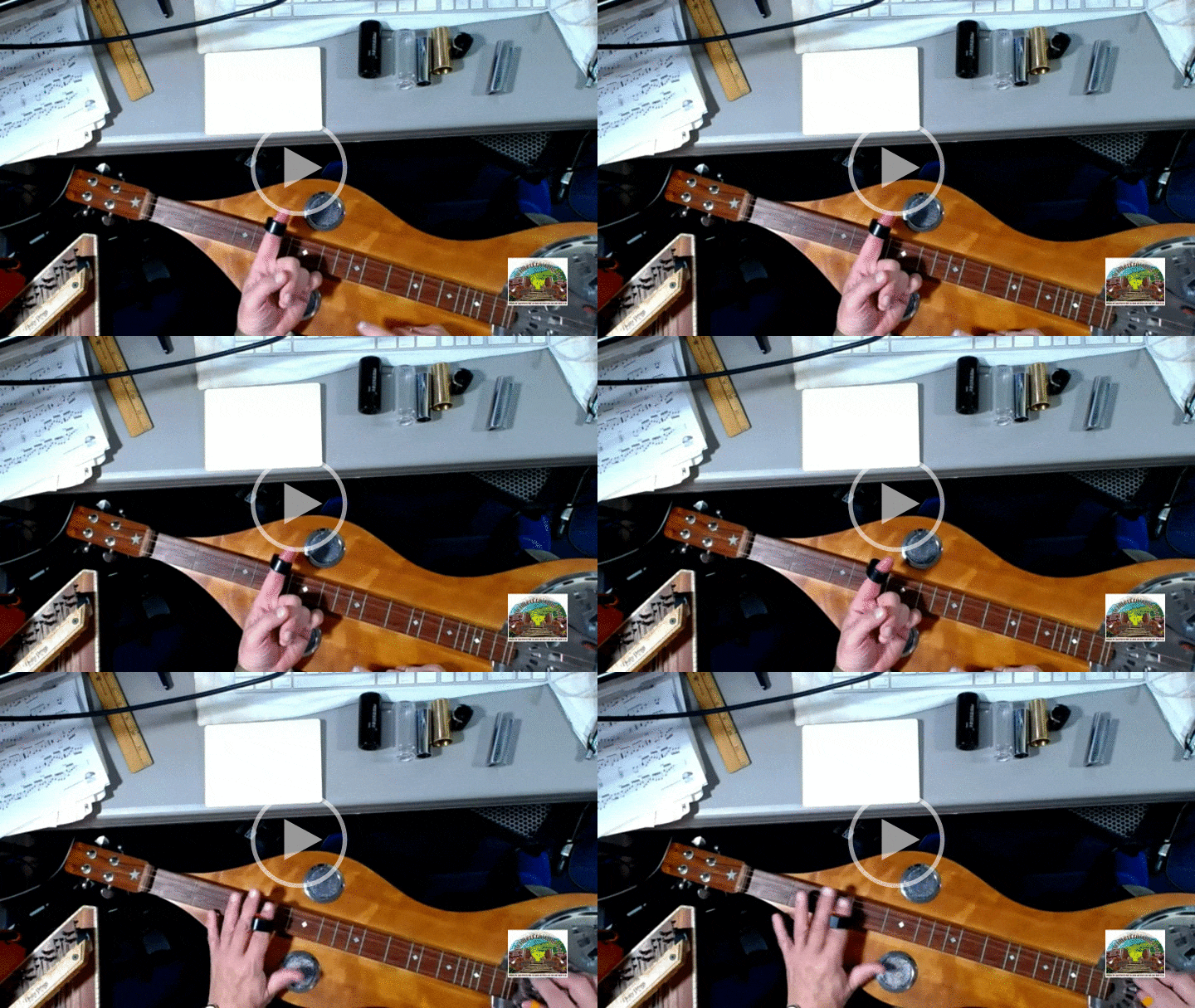
But one of the things that happens with these, virtual festivals is everybody gets a front row seat, and everybody gets an overhead seat as well.
So here's what the hammered dulcimer version looks like.
And when I've got a mountain dulcimer in my lap, here's what this one looks like too.
So you can see what's going on.
Whoop.
I bumped that with my head, didn't I?
Yeah.
So you can see what's going on.
So being able to see and and, listen to the music being guided by someone who's been through it before, being instructed in how to think about the arrangements, those are all ways to learn.
But the other thing is we all bring our dominant learning style to the process as well.
So some of us tend to learn by observing.
When I teach preschool music, there are a lot of parents who are anxious because it doesn't appear to them that their child is participating because all they're doing is sitting there and looking.
And I'm looking at them, and I know they're studying everything I'm doing.
They are participating by being present.
They're observant.
Some people have to do it by the eyes.
Some people do it with all their feelers out, and they're they're doing it emotionally.
Some people are doing the ears.
They may have to close their eyes in order to hear what's happening, or they may have to look out the window in order to hear what's happening and focus on that.
There's a lot of times I'm listening to music.
It may be I'm right there.
I'm so glad to be present with the people making music, but I have to close my eyes to hear the music because I'm distracted by all the visual stuff.
I'm I'm a very visual learner and, and a pattern thinker rather than a linear thinker.
And so even in my in my visual and my audio ways of of receiving the music, I have to take a sense away in order to in order to really concentrate on what's there.
So sometimes you need to close off all the, you know, to focus on one avenue.
Like, a horse has blinders so they don't get distracted.
They can do their work by having the blinders on.
That's not a bad thing.
Now it doesn't it's not good for everything, but it's good if you wanna focus on this one thing, and sometimes we have to do that.
Sometimes it's called carving out quality time, putting something on your calendar that says, this is my music time.
Doesn't matter if the phone rings.
If there's no blood and there's no smoke, then I'm doing this thing.
And, I can always answer.
We live in this world of gadgets.
I can answer later.
Now if I know my loved one is ill or having surgery, I'm gonna keep a special attention to that.
I may have to slide my my dedicated time to some other time, but there's a lot of times when other people's emergencies do not constitute an emergency on my part.
And so taking the dedicated time and saying, this hour, this half hour, this 20 minutes, this 10 minutes, whatever it is, if we carve it out and focus on that for that little period of time, that can that's one way to get us to help focus.
Now in our focus time, we we have lots of different ways of learning.
Again, I'm going back to that because I've run into so many people who think I'm not I'm not a musician.
I said, why is that?
You're playing music?
Yeah.
Yeah.
But I can't do it by ear.
I have to look at the paper.
I said, okay.
You have a skill.
You learned to read.
None of us are born knowing how to read.
None of us are born knowing how to take abstract pictures and have them match sounds.
That's a process of learning.
So at some point, you learned how to read.
Whether it's numbers, whether it's notes and dots and sticks and little squiggly things or little hats or a hole in the ground, all the musical symbols.
We had to learn that stuff.
We weren't born with it.
There's no innate talent for that.
It's a skill.
Now there are some other people that can read wonderfully, and they say they can read music.
They can play it.
They can't do it by e they can't do it by ear.
And and the people who do it by ear say I'm not a musician because I can't I can't read it off the paper.
The reality is we all bring different skill sets.
We all bring different propensities and natural leanings to the process, and we also bring our experience.
Now if we had the experience of a piano or a flute or clarinet or something that's very linear, then we're gonna be tending to look at music in a linear way.
And for those people, sometimes the mountain dulcimer is exactly what works for them because they can see a linear progression that goes up toward the bridge and down toward the knot.
And then the thing to learn is that this note here and this note here and this note here are all the same pitch.
Because on a stringed instrument like this, there's more than one way to get the note.
On the piano, there's only one key.
On a flute, there's one fingering.
On a clarinet, there's maybe only 1 or 2 places where you can have an alternate fingering.
The rest of it is fingering.
You do this, you're gonna get that sound.
Or you're gonna over blow and get the octave.
That's the other thing.
But mostly, linear instruments, you got a way to get the pitch.
And so if I look at notes on the staff, I may not know how do I find those on my instrument.
Ah, so now we need to figure out not only what is the music doing, but how does it relate to my instrument.
And that's one of the things I got a mountain dawson here, so that's where I'm gonna go next.
And I'm gonna go to this tune that we were looking at yesterday.
This is one of the tunes that is, I've been working on.
I did find let's see.
There it is.
I did I did find Ingrid Croce, and she gave me permission to teach Jim's tunes to arrange them for mountain dulcimer and teach them.
So this is one that my class yesterday that that finished, the mountain dulcimer repertoire class, was working on.
That's that beautiful introduction that was the combination of more Mulhausen and Jim Crotch is playing, and they put it together to introduce the the song operator.
And we were talking about all the different things we have to figure out in order to do this tune.
We have these hammer ons and pull and, pull offs here.
These little these notes are littler because they are not the melody.
They are the backup kind of stuff.
And when I get here, the melody is in big and bold letters, and there's some lyrics to help us.
We have to these chords that are stacked up here, we're learning a lot of things here about how to learn it.
And so the first thing that happens with this one is in order for us to play this, we probably need to have a mental map of what the song sounds like, which means if you grew up in the seventies, the sixties, seventies, 50, 60, seventies, this was on the radio a lot.
So you have a mental map of what it sounds like, and that's what draws people to this tune.
I know what that sounds like.
I know what I can you do it on a dulcimer?
And then we look and we see these notes.
Some people read the notes and they know those better.
Some people say, I don't understand these, but I know these eulberg.
And I'm gonna do the eulberg, and I'm gonna do them in order.
And then I got a hammer on, and then I've got a jump.
And that whole syncopated thing that just happened right here.
If I just look at the numbers, I'm going I'm I'm just doing the numbers.
That's that's a piece of learning the tune.
I'm acquiring that.
But then I'm also when I I finally get okay.
There's notes.
There's numbers.
I'm figuring that out, but it doesn't sound like the tune yet.
It doesn't sound musical.
So I have to figure out where are the notes.
What's my best fingering I'm gonna use with my with my hand?
Which fingers am I gonna use with my other hand?
There there's just a lot going on here, and it doesn't sound like music until I've done it for a while.
Because the number on the matchbook is old and faded.
So after knowing where things are, we have this mental map.
I'm following that and making it musical.
So there's a lot of steps in the process.
And as as we're engaged in this process, it it can be very, discouraging to not have it happen the way we want it to automatically.
And we think I'm of a certain age.
I should be able to do this, and we should all over ourselves.
That's that's what happens.
Now the aspiration of I wish I could do this or I want to do this, and I'm gonna invest my energy in doing this, that makes it possible to do it.
But being upset with oneself because we haven't mastered something, which we haven't done before, is really misplaced.
Giving yourself permission to fail, I think, is really important to get it wrong, to give ourselves the ability to do a crappy first draft.
Anne Lamott is one of my many I have many, many favorite writers, but I really like her writing.
And this morning on Twitter, she wrote she said, if you're a writer, you gotta stop not writing.
No one else cares whether you do.
You gotta sit your butt in the chair and stay there until you write a passage or finish a conversation or do something.
Just finish the 1st crappy draft and then go reward yourself with candy.
It just cracks me up.
But it's true.
No one else is gonna do this for us.
So we have to have the desire, but we also have to make time.
We have to take all of our skills and bring it to the game, and then we might ask for help.
And so one of the things that happens in the class session, and that's when we're interacting with someone, is someone says, I get this and I get this, but here.
And so I was asking yesterday, we talked our way through.
My process was to let's just play the chords that are stacked at the top of the music.
Let's do that.
We're gonna play from chord to chord, kind of like a cue to cue rehearsal if you've ever been in theater where you're you're not doing everything.
You're just going, okay.
Here's the cue.
Here's the cue, and that's how the tech people run.
Okay.
Here's what the lights are.
Here's what the props are.
Here's what the scenes are.
So they can just get that into their it's not musical.
It's very mechanical.
It's going from step to step.
And it's letting us take care of those things so that we can get to the music later.
But as we look through, we went all the way through with chords.
And because of this tune, so much of this, the intro is also an interlude between each verse, and it's also the it's the closing.
It's the finish.
So that's something that shows up a lot.
So we spend a good time there.
Sometimes, I'll start by just saying, let's just play the melody notes, which are the big bold ones.
And we'll go through and only look at those so that we can hear the melody and say, oh, yeah.
Here's what's happening, and here's what I have to do.
But this one is interspersed with all this extra stuff.
So we did the extra stuff first.
Different way different way to approach this tune.
And, and then we started working through and going through.
Okay.
I got the a part, got the b part, And the b part, in this case, is the chorus.
And then we get to the next page, and it's like there's a weird thing that says there's no chord.
Oh, sometimes we don't have a chord.
And all we do is hear the melody going when there's no chord, and then the chords come in back in after that.
Sometimes we do some navigation.
Sometimes we figure out the hammer on the pull offs and the fingerings.
And sometimes we say, I don't know how I'm gonna get from here to here.
What's your strategy?
So what I ask people is, where do you think your stumble points are gonna be?
And where do you think you're gonna need to woodshed on something?
And woodshed is we've talked about this before, but I'll say it again.
Taking that difficult thing in the tune, out of the tune, working on that, and then putting it back in and stitching the edges together again.
So we put it back in context instead of practicing the whole song and stumbling over the same point every time.
Now if you're on your own and there's no one to remind you to do that, one of the things you can do is keep a pencil handy.
And every time you get to that spot or if you're working on music on a tablet, make sure that you have the edit function so you can circle where your difficult point is and make that your okay.
I'm gonna spot check this.
I'm gonna do 20 times of just this thing, and now I'm gonna play the song.
And I guarantee you, if you put focus time in on that one spot, that will no longer be your weak spot.
It might and what happens is I'll do that, and that's not my weak spot anymore.
Stephen Schneider, hammer dulcimer player, wrote this in an article in the dulcimer players news many, many years ago.
When you make your weak play strong, all of a sudden, the new weak play shows up.
And it's like, oh, the learning process has is never ending.
Right?
Now let's turn our attention to hammered dulcimer.
And I wanna I want to, this is the the tune that was for the the final one for the week for my hammered dulcimer class this week.
And this is one that I wrote.
It's called the Winsome Waltz.
And let me get it just a little bit bigger.
There we go.
And then I'm gonna transfer that camera.
Now you can see that we're in a minor.
So And one of the students says, oh, I wanna thank you for this tune because it's driving me crazy because it's making me this is I love this.
She said, it's making me go all the places on my dulcimer that I've never been.
We often don't think about this g sharp that's over here underneath the a.
And what we're getting is the harmonic minor scale, which is a strange pattern, but is present on the hammered dulcet.
I'm going to the bass bridge.
I go up, and I have to skip the right side of the treble.
I can find my other note.
That one note I need, the t do.
If I do it straight up, let me do that again.
And let's see.
I have to go one weird place.
But it's here all over the instrument because this is a chromatic instrument.
That's why.
So what I was having her do, she said, I've never had to go from this g sharp over here.
I didn't even know where it was to that f over here.
And at the very end, oh, and then we need this d sharp if we have it up here.
And she said, I've never played that note before.
And so what happens is by choosing a tune which helps us explore our instrument, which we may become you know, we might be weary of how of our playing and all that, but now because we have this piece which gets us allows us to go find all the other things here and use them in a piece of music.
That's why she was saying thank you for drive for for providing a piece of music that's driving me crazy.
But it means she also had to think.
She said, and I'm a piano player.
I think linearly, and I can't with this.
So it's really she teaches piano in college.
So she's very good at what she does, and she's applying that music to this.
And, one of the other students was also a very linear string player and said that this this was helpful for her learning as well because it made her think about things in a different way.
And we have all these notes on the hammered dulcimer, the exact same pitch just like on the mountain dulcimer.
Which ones am I gonna use?
So it's the same process here.
Where what is the music doing?
Where are my notes?
How do I get there?
What's the best way to get there?
And where am I going after I get there?
So, again, there people will say, what's the best way to do this?
Depends.
Depends.
There are some variables at work that we'll need to explore before we know the answer to that.
Because for you, what works for you may not be the same thing that works for somebody else.
Now I've been just talking on and on about this, and I want to just check-in.
Yeah.
Here we go.
And see.
Yes, Jim.
You're right.
Anything worth doing is worth doing badly until you can do it better.
That's a good quote.
I also want to, if you have any other questions or things you wanna, throw in here about your own experience, I'd be glad to to, talk about that.
I also wanna just let remind you or let you know I had this up at the beginning.
I'm I haven't been able to give a full concert of my own since I moved from the Bay Area.
A lot going on.
I've been able to do short festival sets, and festival sets are very compressed.
But I have a whole hour of, music tonight.
It's gonna be 8 PM EST, which is 7 PM CST, is 6 PM mountain, which is my new home time, east, 5 PM EST and 4 PM in Alaska time.
So that's coming up tonight.
It's on online concert thing.com, and that's where you can get the tickets for that.
And I would be glad to see you there.
If you have, if you have a song suggestion that you would like to have included, I'm open to that.
I you know, depending on how close it is to the concert, I may or may not be able to get it in.
But, I'm I'm always interested in in, the things you would like to hear as well as what I wanna play.
In fact, because what I've been doing is concert sets, short festival sets, this whole year, I'm gonna go look at my lists and say, here's the here are some tunes that didn't get on the list.
The other thing that I did in that, I I made a secret goal that I wasn't gonna repeat anything from 1 festival to the next.
What often happens and this is this is completely separate from the topic for today, but what often happens is we have, you know, like, these are the tunes.
It's kinda like you have your company meal, though, when you're having company over, this is the go to.
It used to be for me, it was, pasta shells or manicotti.
It was like, for a long time, that was having company.
This is what we're gonna have.
And you kind of get into your rhythm, and it's not a lot of anxiety.
You just get all the ingredients, put it together, cook it, and then and then eat and have fun.
Well, that's the way that it can be for us as performers.
We have certain tunes that always get played, and there's a whole bunch of other going, what about me?
What about me, coach?
I'm on the bench.
Send me in.
And so what I started doing is is trying to be certain, and I've been successful so far, that I didn't repeat any songs that I played in a festival.
Actually, going back to, last December in the quarantine, Christmas concerts.
And so I've played something new each time I'm keeping track.
And what's what I what happened I played?
And it's made me get excited about my repertoire in a different way that often going to a festival doesn't have the same I don't have the same process because it's like, well, here's these people, and they wanna hear these different things.
And so that's what I'll show.
That's what I'll prepare.
That's what I'll deliver.
And, so tonight, I'm, I'm sifting through what are the tunes that either haven't played in a long time or maybe never.
There might be something that's brand new that I've not shared with people before.
I've played myself, but I haven't shared with people.
But if you have a have a request, you can feel free to do that.
And this is just a reminder.
Again, Saturday is the you're welcome, Talon.
Saturday is the last day to register for the Quarantine Festival.
The Quarantine Festival happens the 1st weekend in June, and, there are a lot of classes still available.
I know many people are grieving because they didn't get into the class they wanted to get into, and we've all I don't know if everybody's had that experience.
I've certainly had that experience when I was registering for classes in school, and it meant waiting a whole term sometimes to get that required class because, well, it's required.
Everybody has to take it, So there's a lot of competition for it.
But I'm excited about what I'm teaching, and, I'm looking forward.
We've got a bunch of new teachers gonna be there this time.
So there's a lot more opportunities.
So if you haven't been there yet, I encourage you to go to virtual dulcimer festival.com.
That's not gonna there it is.
And, peruse the offerings.
There are still several that are available, so you can get your seat.
It's also very affordable, and you could front end your summer with what what it is you wanna work on and take time over the coming year to work on those things.
And I will also be offering my summer, session.
I'm in the process I'm planning that right now, but I'll be offering my summer session in in July, that will run for 6 weeks, my 6 week classes.
I had some that I had to cancel in the spring term and because I had my cataract surgery and, surgeries because they were taken 2 different times.
And so those will be I'll make a make plans to offer those again so that if you were hankering for that, now you'll have a chance to do it.
If you have some some titles or some class themes that you'd be particularly interested in, I'd love to hear those too, and you can leave them here as comments at dulcimer crossing.
You can write to me directly at owlmountainmusic.com for, class suggestions.
If you have some people have some suggestions, and I take those into account.
Well, that is that is what I have for us today.
And, of course, this will be archived here on the Dulcimer Crossing Facebook page.
It'll be archived also on YouTube as well as the livestream, archive at Vimeo.
And we're in the construction phases and making good progress on the new Dulcemer Crossing site.
They'll be archived there as well for the workshop members who wanna have access to all of our, sizable archive of of live livestream events and live teaching experiences that we offer as well as the ones that are upcoming.
And just to plug, Aaron May is hosting a chromatic mountain dulcimer summit the end of July.
And I don't know if that's all available, but I just wanna put it in your ear.
And I know a piece of that is something that we're gonna do as as a live event for our our summer schedule.
And we've got other things scheduled coming up in the fall.
So I wish you all the best, and I look forward to hearing from you.
And, we'll see you again next week.
Bye.
There are so many different ways that we learn music, and all of us use most of these ways to different degrees.
0 comments
Leave a comment
Please log in or register to post a comment