
Course Content
-
0 / 4
Mountain Dulcimer Sample Lessons
-
0 / 4
Hammered Dulcimer Sample Lessons
-
0 / 1
Chromatic Dulcimer Sample Lesson-Erin Mae Lewis
-
0 / 1
Dulci-Bro Sample Lesson-Steve Eulberg
-
0 / 1
Fiddle Sample Lesson-Vi Wickam
-
0 / 10
Sample of Live Stream Archive
-
Learning-How We Learn to Play Music
-
Theory-Dulcimer Range Comparison
-
Skills and Techniques-Finding a Daily Rhythm for Practice

-
Performing-Keys and Building Set Lists

-
Technical Considerations-Is It My Dulcimer or Is It Me?
-
Tools-Using ALL our Tools to Assist our Practice

-
Genre-Bluegrass-Strategizing Solos

-
Tune Time-Devil in the Strawstack

-
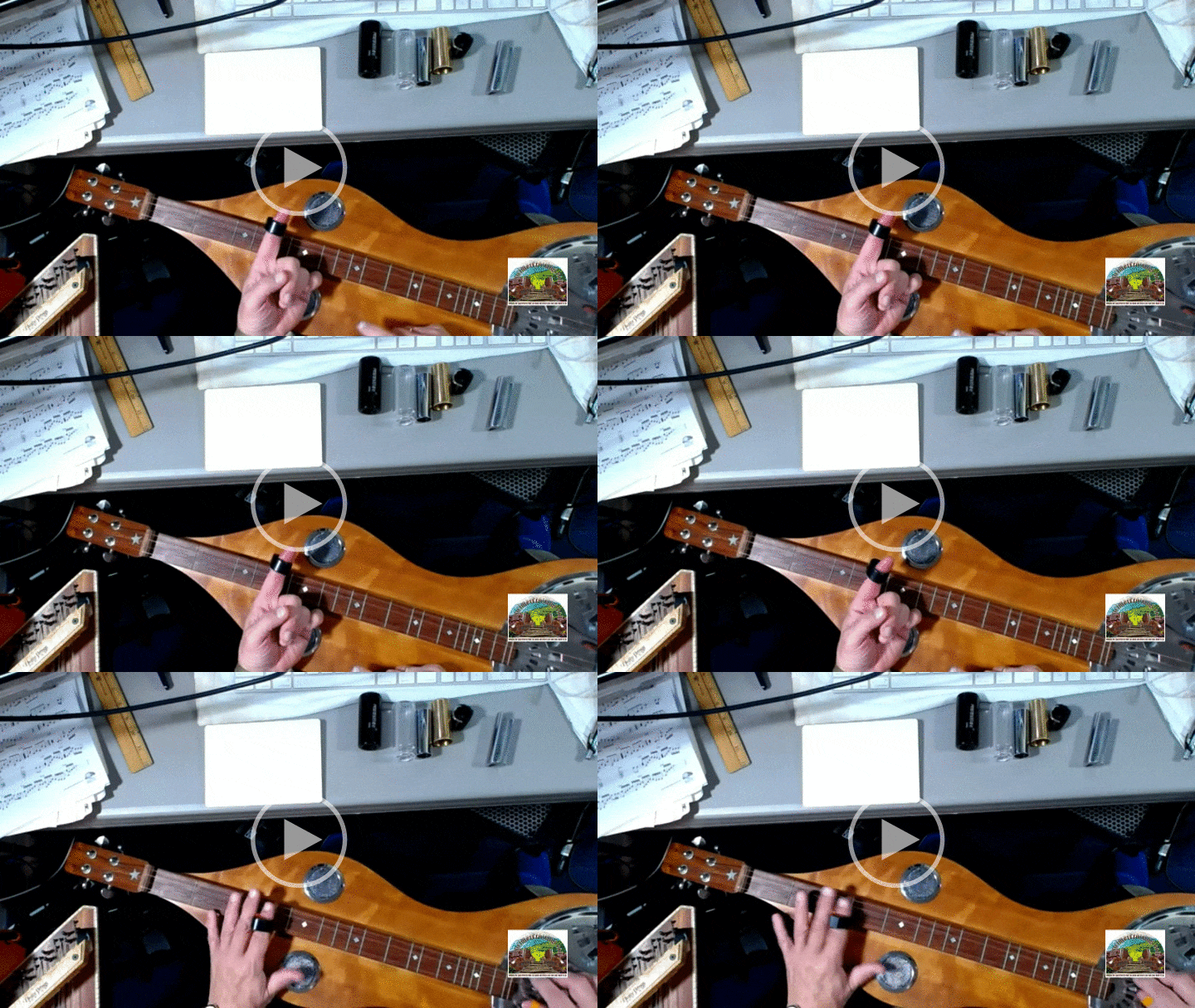
Instrument-Specific-Dulci-Bro
-
Down the Rabbit Hole-Bowing with the Mountain Dulcimer

-
-
0 / 1
Want access to our entire course library?








Genre-Bluegrass-Strategizing Solos
43:18
Alright.
We're trying this again, friends.
Welcome with a little delayed welcome to the Dulcemer Crossing Wednesday livestream.
I'm Steve Eulberg, and we had some technical difficulties earlier, but it appears that we've already ironed them out with the traditional fix of stop everything and start again.
And so and you're hearing the voice of my good friend and far flung neighbor, Erin May Lewis, who's coming to us from Wichita, Kansas, and she's got some friends with her inner studio today, which is really exciting.
Yay.
So today, we wanna talk about improvising.
Oops.
I gotta send the send you to the stream.
No one could see.
Yay.
Oh, do you wanna wave?
This is Elaine.
Hi, Elaine.
She doesn't wanna wave today.
That's okay.
Welcome.
And, today we wanna talk about improv improvise improvising solos and some strategies for doing that.
This is this a question you hear about hear from a lot of people?
Well, you know, it it's one of those things that when I mention it tends to result in deer in the headlights look.
So I have experienced some amount of fear and trepidation about about it.
Okay.
Bye bye.
Right.
And so the other thing is people just say, how do you what are you doing?
How do you do that?
So we wanna explore some different strategies that we use.
And I thought one of the things we could do first is look at one of our videos of playing together.
What do you think?
I think that's a great idea.
So here we are.
I think we might have shown this to you on a future, a previous on a future one on a previous episode, but I just wanna we're I'm playing dulci-bro.
She's playing chromatic dulcimer.
We're playing the same tune, but we're not playing the same thing at the same time.
So let's Hi.
Hi.
Steve Eulberg.
And Erin May.
Another restaurant Restrop.
Restrop.
Another restrop concert.
Another restrop concert.
Oh.
In Ohio.
We make you a little road weary.
What do you think?
Maybe.
I don't know.
All the way from Wichita, Kansas to outside of Springfield, Ohio.
But we found ourselves a shady grove and a dulcimer row and a mountain dulcimer.
So we thought we'd sing about somebody who likes to cut up wood.
Mississippi soy.
2, 34.
F?
And I'm just gonna jump in and say, what did we hear so far?
Well, I noticed some rhythmic variations.
That's one of my favorite improvisations is the rhythms.
And so that that means there's there's a melody and we play something like the melody in a rhythmic way, but what can you say something about what you were doing rhythmically?
You were moving you were you were playing not all the way.
A lot of dotted quarter notes instead of simply quarters and 8th notes.
Duh.
Duh.
Duh.
Duh.
2.
Yeah.
And and 1 and and 3 and 4 and Yeah.
Yeah.
So so that's that is a really fun one.
And I know you like the chop and groove and the groove face and all that kind of stuff.
I do.
That's that's, really in your wheelhouse.
So rhythmic variation is something that we don't.
I'm hearing from Jamie that Facebook's acting weird and a lot of people didn't even get the notification.
So, so, but some people are here and they're participating.
So, we're glad for that.
Doug says husband sighting.
Yeah.
Usually, he's really good at staying out of the way, but there's extra kids.
Tie dye in your house is such a good way to blend in anyway.
It's true.
You're gonna just almost hide.
So the rhythmic, this, displacement is using the ideas of what the rhythm is, but stretching them and pulling on them a little bit, but you could still play the same notes.
Right.
You could put, and you, you chose, the other thing I heard was you chose some chords rather than individual notes.
You played chose to play the chords.
And because you were playing chop chords, there was we could hear the pulsing a lot better.
Chomp, chomp, chomp, chomp, chomp.
Right.
Because there was space in between.
And in bluegrass, that space is really important, isn't it?
It is very important.
Yeah.
In fact, sometimes sometimes contrary to what you would expect, when dulcimers are scoffed at a bit in bluegrass circles, it's usually because they're making too much noise.
We think of ourselves as a quiet instrument, but when we are strumming strumming strumming strumming strumming strumming, we're we're being noisy.
And so and then we strum louder because we can't hear ourselves because we're being too noisy.
So really and truly, you can hear yourself better if you play less because you only hear it every once in a while.
So it stands out more and everyone else has space too.
So those spaces, they're important.
Right?
So, so that's, we're, we're specifically looking at solos in the bluegrass genre and because soloing is such an important component of the genre Old time, everybody's expected to just keep playing, playing the melody Right.
Over and over again until it's kind of like, Don Petty will talk about it being like a zen thing.
When everybody is all playing the same thing, It's like the there's a community, you know, the whole community is But energy kind of builds and builds and builds and builds.
Yeah.
And it's, it's the beauty of that one thing.
Bluegrass is not that style.
It's built on it.
Yep.
But it's built on some some exploration and, everybody getting a chance to do their part and the the widespread of, you know, you got the bass done here, you got the guitar, and you got the the dulce the mountain dulcimers overlapping a little bit of the guitar and is between the mandolin and the fiddle and the guitar.
And the banjo covers some of that, but it's real twiny.
It's got the same bottom note as a mountain dulcimer, but it's it's got a completely different timbre.
And the Dobro, which I was playing a Dobro dulcimer that has the constant kind of wine sound that, is a different timbre yet from the banjo.
So you've got this wall, you know, kind of wall of sound, but everybody's got their distinct place in the sonic spectrum.
Right.
Either for pitch or for timbre reasons.
And when mountain dulcimers get together and they join in, we're there's a space that a lot of other people already have.
So what is our space in that place?
And I know that sometimes what I'll do, and I saw you do it, is you went up an octave, and you start playing it at a higher octave, which is a more fiddle mandoliny kinda place.
Right.
And and because we were both playing in the same space, even though the timbres were different, when you went up the octave, something happened.
And when I went down in the octave, something happened.
So simply moving to a different space from where everybody else plays is is a thing.
Playing playing the rhythms differently is a thing.
What else did we get?
What else did we do?
There were definitely some melodic variations to the tune as well.
So we didn't just play it the the same exact melody notes every single time.
There's some amount of sort of bouncing around the melody.
How could you do that and get away with it?
Well, shall we talk about some principles?
I think we should.
Generally, you're playing in a key.
And when you're playing in a key, there's certain notes that sound good next to each other.
Those are the notes that are part of the major scale.
And to to even a a sort of narrower scope, the pentatonic scale gives you a a series of 5 notes inside of the key that you're in that are like the safe notes in that key.
They work against all of the chord changes.
So if you want to start trying some improvisation, one of the first exercises that I have people do, and I'm holding my chromatic dulcimer, don't be alarmed, is to just try playing sounds at open on each string, the first fret on each string, and the second fret of the bass and melody string.
And those are the 5 notes.
Open on the bass, 12.
Open on the middle, 1.
That's 5 notes.
And then whatever you play on the bass, you can also play on the melody.
So open 12.
And to just start noodling with what are the sounds you can make just in this space.
And you should be able to go for, I don't know, at least an hour, I'd say, just playing those those five notes.
You know?
You can you can stay busy for a while.
Now there's something else you're doing right there that we didn't talk about yet, and that's changing the accents.
So you're articulating the pitches a little bit different.
They're not all the same.
And.
We think of bluegrass typically as a boom, Chuck, boom, Chuck kind of sound.
And, you know, bass is playing on 1 and 3 or all the beats and everybody else is playing on the off beats or everybody else is playing on 3 or 2 and 4, with the chops.
But when you're accenting, are you X, are you playing into that expectation or playing against that expectation and or both?
Yes.
I definitely I definitely tend toward accents on twos and fours.
Some you're more likely to hear me go.
1 and 2 and 3 and 4 and 1 and 2 and.
And sometimes even just the twos.
1 and 2 and 3 and 4 and 1 and 2 and 3 and 4 and 1 and 2 and.
So you have this strong, like, off center kind of accent placement.
Uh-huh.
Yeah.
What do you lean towards accent wise when you're improvising with bluegrass?
I I tend toward to lean toward that syncopated clave rhythm.
So maybe a 1 and then a and of 2.
That's where my brain goes in the first place, which means it's borrowing from the Caribbean because that wave rhythm is really a Caribbean Latin kind of a feel.
And that that may get some people looking at me weird, but the fact that no one else is doing it means other people pay attention and say, why?
Because it's something different.
Yeah.
Yeah.
And I I like the the strong twos and fours is very much an old time sound.
It's the fiddle shuffle sound.
That's that's that, like, get make you wanna get up and dance sound.
And I I lean pretty hard into that even in my bluegrass soloing.
Yeah.
Yeah.
Now I know that, and we this wasn't demonstrated in what we showed today, but I know that you also use dynamics as an important piece of what you've used.
Can you tell us what you're thinking about when you're, when you're, you're changing the dynamics in your solos?
That's a that's a piece that I would describe as the tension and resolution piece.
So when I am playing a solo, I want some parts of it to have more tension, some kind of tug and pull.
And then I want other parts of it to feel like there's some resolution.
And the dynamics are one of the ways that I do that.
So I I use them kind of both ways.
Sometimes a softer time creates more tension because it makes you, like, lean into it.
So it's making you, like, wait for the next sound to come.
So there are times when I'll get really quiet to create that space where then I'm gonna come back in with more volume.
And sometimes I'll sort of make a solo go up and up and up and up and up and up and up and up and then kind of drop back to a quieter place.
So the dynamics are helping me sort of tell the story of tension and resolution within the context of the, the solo construction.
Uh-huh.
There is an there was a word you used, and I can't remember what it was now because I followed you.
I just started listening to what you're gonna say instead of picking what I was gonna say next, which is supposed to be a really good thing for listening and thinking.
But I the other thing we did is there were some chord surprises.
There were some chord surprises.
There was some changes of the rhythm underneath of the solo too.
We switched from a 4 field to a 2 field in the accompaniment, which changes the way you solo over it too.
So both in the accompaniment and in the, solo, there is some improvisation and some crafting of that.
And it was not something we sat down and said, no.
We're gonna do this and you do that, and then I'll think about doing this.
That's not that doesn't mean that that can't be a way to work.
Mhmm.
It's there can be some some value to say it's I'll go first, you go second.
We'll we'll do something, and this keeps that pattern going.
But I noticed that when I did something different, you looked.
You looked over.
Mhmm.
And you you I I don't remember in this example if you had already started on something and changed, because I know that sometimes we do that.
It's like you had an idea and I had an idea, but we didn't check we didn't have a chance to check it out.
And it's, it's like dancing with somebody and and moving your foot so you don't step on them.
You know, it's Yes.
Yes.
Yeah.
If if that would be constant and every time you had an idea, I went first.
I think that would, that would harm our, musical relationship because it doesn't feel fair.
So And it doesn't right.
It doesn't have the push pull.
Yes.
Right?
If you're playing if you're playing a game or tie I've thought of tug of war and I'm not really sure that's a good example because in tug of war, you're trying to only pull.
Right?
But there is this, like, sort of balance of the push pull.
Maybe rowing would be a better example.
Like, both sides have to row, and if only one side does that, the boat goes in a circle.
Right.
And your music kind of does that too if there isn't that side of sort of equal listening back and forth.
And you take an idea and I take an idea and we we do.
And there are definitely times when one or the other of us is more familiar with the starting point.
Yeah.
That's true.
You know, one person is sort of leading the song and the other one is following.
It's important that in that situation, the leader recognizes that they're the leader and takes that leadership.
And there are times when we both sort of equally know where we're starting from, and that's where we can really do that beautiful dance of you take an idea.
I take an idea.
You start to play something.
I hear that happen.
And I I follow by matching the texture with you or you know, when when we did some of those alternate chords, it was like, oh, here's a space where alternate chords could go.
And then we took turns choosing what the funny chord would be.
Yes.
And yeah.
So I think it's yeah.
All of that.
And it and in that case, because we hadn't talked about it beforehand, I just I I didn't say we're gonna play, let's, mess with Mississippi Sawyer.
We just played it and it's something that I've done a lot.
And so I just said F And and you weren't thinking, oh, we're doing consonants now.
You you it's it's like, oh, yeah.
Something different's gonna happen here.
And before that, I had used the c chord as a little bit of a surprise.
And that's, you know, so you already knew that something might happen.
Something surprising could be there.
Yeah.
Yeah.
Yeah, yeah.
So, so the improvising is not just about what am I thinking about what I'm doing, although I have some strategies for that and you have some strategies for that.
It's also, is this the place to do it?
Is this, is this the space?
And sometimes, you know, when you're playing, players will not look at each other and they'll know it's my turn.
Because of because they've played together, it's almost like the shortstop and the 2nd basement turn in a, double play.
Do you throw the ball where they aren't yet?
Because you know they're coming over there and they're gonna catch it.
Uh-huh.
And Uh-huh.
And I'm not thinking this is what's gonna happen.
I don't have time to think.
I've got to get the most rid of it and that person has to turn, you know, it's, and it's because we do it a lot.
Yeah.
And like you said, we both, sometimes we both know the songs or, or you'll say, I've got this song I'd really like to do.
And I said, well, kick it off.
I don't know the song.
But because I trust that you love this and it's gonna be important, I wanna know what it is, and I'm gonna be looking where are the places is where's the room here?
Is this a solo piece, or is this, an ensemble kind of piece?
And how can we put that together?
Yeah.
Yeah.
I'm I'm thinking about another idea because bluegrass is not just about, you know, it's, it's not just about Kentucky and being the bluegrass state, but there is also within the genre a little it's, it's some use of some blue notes, Indeed.
Some flatted thirds and things that you don't expect necessarily.
Lots of flatted 7ths too.
I mean, that kinda makes the Lydian sound from the old time mountain tunes definitely weaves its way into blue bluegrass a lot.
And, and in blues, the flat at 7 is a great place to, to do any melodic.
If I always have people will just play blues chords, I'll play the chord progression.
If you just stay on the flat at 7 of whatever the chord is, it sounds bluesy.
So if we think about it that way, that's the first place.
The second place is the, is the flatted third.
So I'm playing golden slippers, but I'm putting the flatted 3rd in with it.
And I'm filling in I'm doing the filling in the gap thing.
I wanted to show I've got an example of what filling in the gap can the half, the, the notes that are not the safe notes that are not part of the key.
So even, you know, there's a way in which, when you're, when you're playing an improv solo, there's nothing that's wrong.
There are some things that are gonna feel a little further a field, but, but, they're still not wrong.
They're just a little more distant from being as right.
And and I don't know about you, but there are times when I feel myself being lost.
Like, I've lost my sense of where in the form I am.
I've lost my sense of what chord we're on and and kind of how the shape of the piece of music.
And so there there can be a feeling that I'm lost.
Even if I'm playing notes that sound okay, I can sometimes, in my mind, have gotten lost.
And so sometimes I need to be rescued by somebody, like, really, really giving me a strong cord leading.
And, I mean, usually, there's someone in the circle who recognizes that you're feeling lost because you your solo begins to make less sense.
Mhmm.
It doesn't have a, like, intentional going up or down or leading you toward something anymore.
It's like you're just hanging on.
And, so so I do think that there are times when you feel lost, which doesn't mean that the notes that you're playing or the improvisation that you're doing is bad or wrong in that moment, but it can lead you to feel differently about it.
Yes.
And that's that's the ensemble of people working together is you're not really trying to leave somebody high and dry.
Right.
You're you're paying attention.
And, I don't know if I'd call it like sheep dogging, but you're making sure that everybody is not gonna be thrown to no one will be thrown to the wolves.
Right.
Now in jazz, that's a completely different thing.
Right.
Because cut sessions in jazz, they will throw you to the wolves.
And that's, you know, a story of, Charlie Parker in Kansas city going to play and the, and the drummer took the the nut off the top of his cymbal and threw it at him.
You know, it's it was really a cut cut session.
And, I have none of my jazz experiences have been that where I would be way more scared than I already am.
I'm moderately scared of jazz anyway.
Well, I I think the, I think if we change our focus from the fear of being wrong to the possibility of joy.
Yes.
If I say, oh, I'm gonna have some joy here.
Now there may be, it might be joy wrapped in other stuff, but I'm going to try to, I'm going to try to have a moment of joy.
And maybe my joy comes from appreciating what you did that I didn't think of.
And maybe it comes because I thought I was gonna fall off, and I didn't.
Yeah.
I mean, I can't tell you how many times I've gotten to the end of the solo and been like, that worked.
Hey.
That worked.
Yeah.
Yeah.
It's a good feeling.
I made it to the end.
It worked.
I got all the way there.
Now the other thing that's interesting is there are different ways to trade solos.
You could trade eights, which is there 8 bars.
It's like you're doing an a part and then somebody else picks up on the second a part, or you may have 16, it's your job to play all of them, or you can trade fours.
So do you do a phrase?
And that would be we're trading fours.
We can trade twos, you know, and that's that's stuff that is much more common in jazz than it is in bluegrass.
But in a crafted performance of bluegrass, you will hear that.
Yeah.
Or the fiddle does something, and then there's the banjo doing something, then there's mandolin, then there's a dobro slide, and the guitar's got a lick, and then there's all this everybody stops in the boom boom boom boom boom boom.
But that's that's use that's less of a jam experience and more of a performance.
Yeah.
It's definitely done jams where we trade parts.
You do a part and then the next a part and then the next b part, but usually not shorter than that without train wrecks.
Yes.
Yeah.
Yeah.
Yeah.
Yeah.
I think I think those things happen when you've got, you've got more trust playing together.
Yeah.
Right.
And it's probably when you've done it for a long time.
Like when you're on tour, it gets a lot easier to do that kind of stuff because you're playing every day.
Right.
And you're playing with the same people.
And you may not wanna play what you played yesterday, or you just might be a little impish.
Let's say, I wonder how this is gonna go.
Your turn.
But but you gotta know that if you do that, it's coming back at you sometime.
It will indeed.
Careful.
Yeah.
And, you know, there's there's I think for me, there's different strategies if I know the tune well.
And if I don't know the tune well, you know, I'm if I don't know the tune well, my strategies tend to be to really, kinda hug tighter to that pentatonic scale and just try to move in the direction that I feel the the general melody is going.
So I'm generally moving up or I'm generally moving down and I wanna try to get home at the at the time that the song gets home, you know.
Yes.
And and if it's something that I do know the tune really well, then I'm trying to weave the melody into it, but also play out sort of around the melody.
And that's where those, like, next door neighbor notes come in.
Or if I know the melody sort of, you know, Mississippi Sawyer kind of goes from 4 to 3 to 2 to 1 in mountain dulcimer tab, from the 5th of the scale to the 4th of the scale to the 3rd of the scale and kinda walks down in the a part.
And so I know that, but I also know that if I start on the 5th of the scale, I could walk up.
So it's possible for me to just turn the melody upside down and walk up to the octave instead of walking back down to it.
So there are times when my improvisation is knowing where the melody usually goes and then walking the melody the other way as a as a way of improvising around it, knowing that where I need to land when I get there.
I'm a lot more likely to do that kind of improvisation when I do know the tune really well, though, than when I'm just trying to figure it out.
Right.
And and sometimes I've heard wonderful solos, which are just playing the melody, but using alternate picking.
Uh-huh.
Instead of.
And it, it, it feels enough different.
So it doesn't, it doesn't have to be anywhere out of the realm of anybody.
Yeah.
And, you know, you'll hear that a lot in, in early bluegrass from the mandolin solos.
I think of, like, Jim and Jesse and the Osborne Brothers and Bill Monroe.
And in a lot of those early recordings, a lot of the mandolin solos were that alternate picking on the melody.
So it's a very classic bluegrass sound, really.
Yeah.
Don't hear that as much in Newgrass.
I guess that's where we're it's gonna be more jazz influenced.
Right?
Right.
Right.
Yeah.
But the other thing that happens is the cross picking through the cord, which that's a that's a Robert force kind of thing.
Yeah.
And, you know, the guitar players often will do that.
They'll kind of play out of a chord shape, but the banjo players really do.
So the inspiration for those playing through the chords in that cross picking way, that's a very, bluegrass banjo kind of stylistic approach.
Mhmm.
There's a lot to be learned from all of the different instruments in the in the bluegrass traditional bluegrass ensemble from which the mountain dulcimer then can find their spaces to fit.
So so one here's, here's a, here's an assignment is we could go listen to a particular piece and try to play.
I'm gonna try to play a banjo type solo.
I'm going to try to play a mandolin type solo.
I'm going to try to bait play a base type.
So I'm going to try to play a guitar type solo and listen with ears to pick out what's the difference.
What are what might be their different strategies as they're playing.
Mhmm.
And the beauty of living now is there's a lot of recorded examples of that that we can There are.
Study.
Yeah.
Fiddle players are gonna use slides a lot.
Can you use slides?
I transcribed some Dobro solos in college because the Dobro was the instrument we didn't have in our ensemble, and so the was taking the Dobro place.
And it works.
There's a lot that you can draw inspiration from from each of the instruments.
Yeah.
Yeah.
Oh, this is fun.
I bet we could probably do this for a lot longer time.
Probably all day.
I guess we'll have to come back and do another Dulcimer Crossing Wednesday livestream together.
I think we will.
Let's let's plan on it.
Yeah.
Deal.
Before got a live workshop coming up, don't we, this week?
We do tomorrow.
And now I've gotta go open that up because I had all that stuff ready before I had to restart.
Oh, I had to restart everything.
Yeah.
So tomorrow is our, monthly live workshop, which, workshop level members have automatic access to and everyone else can upgrade for a month if you wanna join the workshop or just purchase the workshop as a standalone item that you wanna attend, helps us pay the artists who come and give their time to do the workshop.
And this month is Colin Beasley.
And he's he's a hammered dulcimer player from Mississippi, and he's gonna be talking about hand independence playing melody and harmony at the same time.
We always offer the translation of the other instrument between Aaron May and I.
So when it's a hammered dulcimer instructor, we will be available to talk about how this is also something can happen on on mountain Dulcimer and how we might apply those things.
And it's always fun because the, the instructor is sometimes delighted to know, I didn't know you had this like I do.
Yeah.
So Yeah.
They are really fun.
And Colin Beasley's calls his style of playing dulcimer gumbo, which I think is delightful.
Yes.
I forgot I forgot that.
Yeah.
Dulcimer gumbo.
I can't wait.
Yeah.
Mhmm.
So it's gonna be a good one.
Whoo.
I bet we talk to them about improvisation in that class.
Yes.
So feel free to join us there.
That will be on, on Dulcimer Crossing.
You can purchase an a one time ticket if you want.
You'll get access to the workshop and the archive recording And, workshop and mentor level students get access to those every month, as well as the archive of all those.
Well, Erin May, thank you for and Elaine, thank you for joining us.
Thank you.
And, everybody who's watching, thank you for being persistent and sticking with us while we work through the there was a little hurdle this morning That happens.
Crazy.
Yeah.
Yeah.
Patience with technology.
But it's a Shakespeare quote.
All's well that ends well.
Just like solos.
Agreed.
Hey.
That worked.
Yeah.
So, we'll bid farewell and, we'll look forward to seeing you in the future.
Thanks, Herme.
Bye, Herme.
Bye.
I'm trying to end, and it won't end.
Keep leaving.
Bye.
Bye.
Bye.
Erin Mae and Steve share and compare their strategies for playing solos in the bluegrass genre.
0 comments
Leave a comment
Please log in or register to post a comment