
Course Content
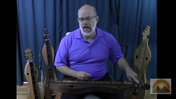




Lesson 3: 1-5-5 Tuning
4:13
I encourage you to have a spirit of adventure when you're tuning your dulcimer.
You may be afraid of that.
You might be afraid you're gonna break a string.
Well, strings can be replaced.
And I can guarantee this, you will break a string.
It's like when I we got our daughter her first drum so she could practice for the school band.
The guy at the drum shop handed her the drum key and he says here's the first drum key you will ever lose.
Maybe crack up.
But it helps set the expectation it's not going to be the end of the world when you lose a drum key.
You can get a new one.
It's not going to be the end of the world when you when, not if, but when you break a string.
You can replace it.
Okay.
So now what do we tune the pitches to and how do we do that?
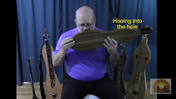
The old traditional way was hooing into the who.
That pitch made my whole instrument vibrate.
That's the one that this instrument wants to be at.
It what is it on the scale?
I don't know, but I know that that's what made the instrument come alive.
So okay.
That's called hooing into the hole, and I just through pitches starting at the top and going down and come back up until I could tell where it vibrates all the time.
Then I that pitch and I make a match.
Now, how do I tune the rest of the strings from that?
This is the traditional way to tune.
Before there were batteries, before there were tuners, before people had tuning forks, they did it by ear.
But I can't do anything by ear!
You've done everything by ear since you were born.
You're just learning the skill again and refining it.
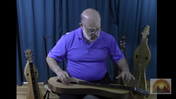
So the typical way, the most normal way you're going to tune your middle string after your bass string is tuned is you're going to put your finger just to the left of the 4th fret.
I'm going to count 1, 2, 3, 4, and I'm going to have to make that middle string match.
I went to the wrong one.
I turned and nothing happened.
So.
Some people reach across like that so they can keep this note ringing.
Did you hear how it came into tune?
I'm gonna take it back out.
When they got really close, there was a little beating, like a vibrato kind of thing.
When they came in tune, that stopped.
That's the trick piano tuners use.
Now what I've done is given my first note is a 1.
I've just made my middle middle string be the 5th pitch of that scale.
The do sa, twinkle twinkle little star.
That's that relationship.
Now what I tune my melody string to depends on my preference.
There are the old traditional way which is the way the instrument was laid out is to have your string be 155 in relation ship, and then my scale starts.
And you might notice this instrument does not have a 6 and a half fret.
So when I play from 3 to 10, I've got all the notes I need for to play major mode songs.
I've also got the notes below do when I need those notes.
They're all in the melody string.
A 155 tuning.
Now, we haven't talked about what notes they are yet, but I've tuned the instrument to itself so it sounds happy.
The other
Don't worry. If you break a string, you can always get another. In this video, Steve teaches the traditional method of "hooing into the hole," the way dulcimers were tuned before we had batteries for tuners or tuning forks. Then he demonstrates how to tune the strings to 1-5-8 intervals.
0 comments
Leave a comment
Please log in or register to post a comment