
Course Content
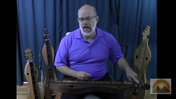



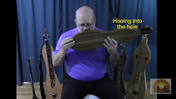
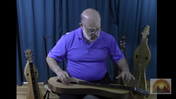

Lesson 2: Pluck, Then Turn
4:48
You're gonna pluck and then turn.
So, pluck.
So, when I turn this time in clockwise motion that makes the pitch go up.
If I pluck and it makes the pitch go down, that's the looser way.
In this case, it's counterclockwise.
Pluck, turn.
Pluck, turn.
If I pluck, and I turn and nothing's happening, it's because I didn't pluck the same string that I'm turning.
And that's anytime you pluck and turn and nothing happens, stop and check where your right hand is.
Make sure that what you're plucking with the right hand matches the string over here.
And that's where we need to know the map of your head.
This one is a scroll head as I mentioned before, and when I follow the string, okay, the bass string goes to this tuner.
The middle string goes to this tuner, and the melody string or strings go to these tuners usually in order of a horseshoe.
Now let's check what it looks like on the other dolsovers.
This one is like that one.
Although the tuners come this way.
When I follow my bass string it goes to the one that's furthest away from me pointing out.
And when I turn this way it goes down.
When I turn this way it goes up.
Now is that clockwise or counterclockwise?
It's hard to tell because my hand is facing away from me.
So I pluck and then turn to figure out which one's lower, which one's higher, which one's looser, which one's tighter.
The middle string, I follow it down.
It stays on the same side.
The melody string, the inside one, goes to this one.
The outside melody string that's closest to me goes here.
So like the other one this is tuned in a horseshoe.
The bass string is furthest away.
The one closest to me is here, and everything else goes in order like a horseshoe.
Now let's try one that only has 3 strings, but they're all on the same side.
Fender guitars are like this.
So if I pluck this this one here and turn this, nothing happened.
Uh-oh.
I tuned the wrong one.
So I follow that it goes to the one furthest away.
Now in order to tune I'm doing the opposite action as I would if my tuner was on this side, which is why I can't tell you right or left when people say which one am I going?
Right or left?
I need to know about your peghead.
I need to know how the tuners are on your peghead.
You're going to know this best because you pluck and then turn and know which way it goes.
So when I go this way, looser that way tighter, which is higher.
Looser is lower.
Tighter is higher.
I try the middle string that goes to the middle one.
Oh, that's nice.
The melody string it goes to the one closest to me.
So when there's 3 this layout is bass middle melody going from lowest to highest.
Now let's look at the other 3 string variety where the string the tuners are facing the back.
My bass string, I follow it, goes to the one that's furthest away.
Now my hand is upside down turning one way or the other.
Okay.
If I go that way, it's looser for lower.
If I go this way, it's tighter for height.
Middle string is the one furthest away.
Same direction.
Melody string.
Okay.
So when it's laid out correctly I should only have to turn one direction all the way around in order for it to work.
But, your dulcimer may vary.
This is why to some rigid standard that stands in the hall of fame somewhere, it's based on your instrument.
So I hope you're brave enough to try and figure out which way to turn in order to make the strings do the things you want them to do.
Before you begin to tune a string, first pluck that string and then turn the tuner. Follow each string to find the tuner attached to that string, so you don't turn the wrong tuner.
0 comments
Leave a comment
Please log in or register to post a comment