
Course Content




Lesson 1: Introduction
4:17
Hi friends.
Steve Eulberg here for Dulcimer Crossing.
I'm excited that you have a dulcimer, and now you want to know how to tune it.
We get this question a lot and there are a lot of videos which talk about restringing and and how to play the instrument, but sometimes we overlook the basic thing.
How do I tune the instrument?
If you've played other stringed instruments, then you have some principles behind you, and you might be more interested in the string layout on your instrument and what are the pitches that you tune to.
But if you've never tuned any instrument in your life, this is what we're focusing on today.
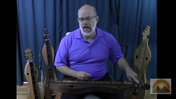
I've got four examples of mountain dulcimers that have different tuning heads.
This one is the traditional scroll head, and the tuners point straight up from the body.
And they turn and that stretches the strings.
Here is one.
This one has 4 tuners.
Here is one that has 3 tuners all on one side, but instead of pointing up they're pointing out.
Here is one that has 3 tuners, but instead of pointing up or out they're pointing back like a banjo head would be or a classical guitar.
Here's one that has 4 strings like this one has 4 strings, but all the tuning pegs are pointing out like the one with 3.
They all have something in common though.
They're dealing with strings.
And so the first thing we need to remember, if you don't remember physics or that scares you, string physics has got three things that are going to affect what we're doing.
Number 1, the longest string is the lowest.
Well, all of our strings are the same size, so that's not going to affect our tuning.
It does affect where we put our fingers.
The second thing is the thickest string is the lowest.
So touch all your strings and see which one is the thickest.
On each of these instruments, because they're dulcimers, it's the one that's furthest away from your body when it's laying on your lap.
So that is called the bass string.
So the thickest one is lowest.
That's going to be the one you're going to tune your root pitch to most of the time.
The other strings are going to be some different gauges that are likely thinner.
There is one exception.
If you're playing a Gaelac style traditional instrument, all the strings are the same gauge.
So there is no bass string.
It's the one furthest away from you, but they're all the same pitch.
Okay.
So we've got longest is lowest.
Shortest is highest.
We've got thickest is lowest, which means thinner is higher.
The third one, and this is where we this is what tuning has is comes into play.
The third one is where tuning comes into play.
Tighter is higher.
Looser is lower.
So that's what the tuning pins or pegs are doing.
If I pluck a string, it vibrates at a certain pitch.
But I can make that pitch change by tightening the string.
I can make that pitch change to go down by loosening the string.
How do I know which direction is going to be higher and which one is going to be lower?
Which one is going to be tighter?
Which one is going to be looser?
You don't know without experimenting because different builders use different tuning pegs.
And sometimes people will accidentally put the wrong one on the wrong side and without testing it you won't know.
So you're gonna have to be brave.
You're gonna have to do something.
This is the process for tuning all the time.
You're gonna pluck and then turn.
First Steve introduces the topic of tuning a dulcimer by showing us four of his mountain dulcimers, all with different tuning heads. Then he explains the physics affecting how a string sounds when it is tuned.
0 comments
Leave a comment
Please log in or register to post a comment